
 |
 |
 |
 |
 |
 |
 |

Public Talk: Expanding Human Rights Spaces for Women in Afghanistan
August 26, 2010
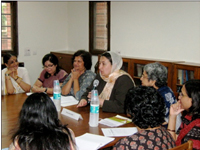
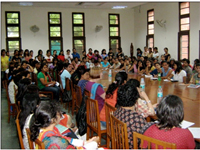
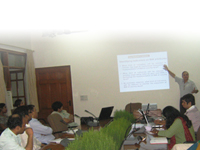
| PWESCR, in collaboration with the Development in Communication and Extension (DCE) Department at Lady Irwin College, New Delhi, India, organised an informal discussion with Ms. Massouda Jalal (Former Women’s Affairs Minister, Afghanistan) and Ms. Maria Virginia Bras Gomes (Member, since 2003, and presently Vice-Chair of the UN Committee on Economic, Social and Cultural Rights) on ‘Expanding Human Rights Spaces for Women in Afghanistan’. Ms. Massouda Jalal discussed the current challenges and issues faced by Afghan women, and Ms. Maria Virginia Bras Gomes shared her observations on economic, social and cultural rights in the context of the recent country review of Afghanistan by the UN Committee on Economic, Social and Cultural Rights. Ms. Jalal depicted the situation of Afghan women with the backdrop of prolonged instability and conflict in the country, and highlighted how political insecurity coupled with financial instability has greatly limited the opportunities for young girls to engage meaningfully with the outside world as citizens of the State. She referred to the days of the pre-Taliban era in Afghanistan, especially the Communist regime of the Russian occupation and the Mujahideen rule. With the Mujahideen in power, Afghan women were subjected to violent and discriminatory traditional practices. With the onset of the Taliban rule, their situation further worsened. Women were forbidden to leave their homes without a male escort and without wearing the burqa. They were punished for breaking these enforced codes of behaviour – freedom of movement and dress, but also restrictions in work and education – with ruthless harassment, intimidation, violence and murder. This volatile environment for women was compounded by long-term poverty, resulting in a high level of illiteracy, serious health problems, life-long imprisonment at the hands of male family members, and ongoing psychological and physical torture. Following the US intervention in Afghanistan in 2001, and the subsequent downfall of the Taliban, women hoped to be liberated from the chains of fundamentalist patriarchal tyranny. However, Ms. Jalal stated that the presence of international community in Afghanistan for almost a decade has failed to induce any real change in Afghan society or in the lives of the women. |
August 22-23, 2010
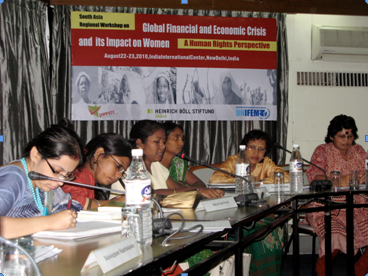
| PWESCR, with the support of UNIFEM and Heinrich Böll Stiftung, hosted a South Asia regional workshop at the India International Centre, New Delhi, India, to discuss the impacts of the global financial and economic crisis on women from a human rights perspective. Twenty-two representatives from Afghanistan, Pakistan, Bangladesh, Sri Lanka, Nepal, and from a spectrum of regions across India, attended the event. Participants were drawn from all sectors including local, State and federal Government and the UN, women’s rights NGOs, Tribal women’s groups, labour unions, political economy, law, media and academia. Ms. Massouda Jalal discussed the current challenges and issues faced by Afghan women, and Ms. Maria Virginia Bras Gomes shared her observations on economic, social and cultural rights in the context of the recent country review of Afghanistan by the UN Committee on Economic, Social and Cultural Rights. The current global crisis began in the housing sector of the US economy, spilled over into the financial sector moving on to the real sector of the developed and developing world, causing immense hardship for millions of poor and vulnerable people in developing countries in the process. Women, in particular, are adversely affected by the current crisis, which itself combines multiple crises: a global economic recession, the devastating effects of climate change, and an ongoing food and energy crisis. All of this is compounding increasing poverty and inequality in different parts of the world, as well as the increased vulnerability of women in particular where adverse health and nutritional impacts are concerned. The crisis is not new for most of the developing countries that have struggled with crises right from the 70’s with women’s group in particular emphatically voicing their protest and resistance to such policies in terms of its destructive effects on women’s livelihoods, increased burdens of work and unpaid labour as well as loss of social security nets. This crisis, however, reached global proportions when it impacted advanced economies and their role in global arenas thereby bringing out the interconnectedness of the divergent realities in a globalised world. |
.png)
August 26, 2010
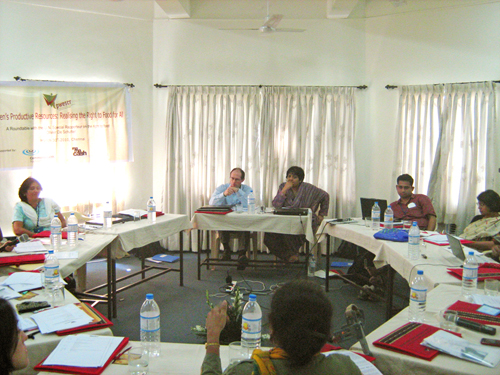
| PWESCR organised a one-day roundtable – Women’s Productive Resources: Realising the Right to Food for All ─ with Olivier De Schutter, the U.N. Special Rapporteur on the Right to Food, in Chennai, India on March 30, 2010. The goal was for women leaders to engage with Olivier De Schutter on gender aspects of productive resources and their links to the right to food. The roundtable was organised in conjunction with the Special Rapporteur’s regional consultations on land, which will inform his upcoming report to the Human Rights Council on land and the right to food.
The roundtable was attended by a diverse group of experts and advocates with extensive experience in women’s issues related to land, agriculture, water, forests, social security, microcredit, the situations of vulnerable communities such as tribals and Dalits, and environmental issues, including climate change. Women leaders at the Roundtable asserted that the issues of productive resources are critical to women because the right to food cannot be looked at just as feeding one self or to just be free from hunger. It has increasingly become difficult for women to live a live of dignity without these resources. Patriarchy, prescribed gendered roles, and harmful law and policies have exacerbated the obstacles that women confront. There are laws that do give women legal entitlements to land. However, women are not land owners. They are working on land doing various forms of livelihood related activities but they are not recognized as farmers or workers either. Several tribal communities in India are facing threats of displacement from their traditional land for various reasons. This trend is particularly devastating for tribal women as they are dependent on land including forests which are primary sources for their livelihood. Women loose their traditional land but get no rehabilitation/compensation for their land as they were not land owners in the first place. Traditionally women are also responsible for procuring water. Therefore, lack of access to water has an adverse effect on them. India doesn’t recognize the right to water as an entitlement. To realise the right to food, it is essential to recognize women as economic agents -- producers, and workers – contributing to the well being of their family and communities.
|
AFGHANISTAN WOMEN LEADERS TALK ABOUT DOMESTIC VIOLENCE & WOMEN
20 October, 08
|
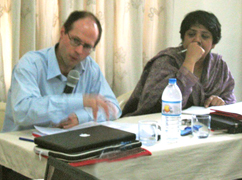
PWESCR organized an informal discussion with Afghanistan women leader |
Women demand Greater Protection for Foreign Domestic Workers and All Women Migrants
15 October, 08 – 17 October, 08
|
|
|
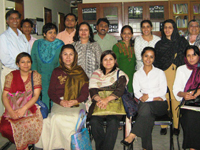
PWESCR participated in the Asia Pacific NGO Consultation with Dr. Yakin Ertürk, United Nations Special Reporter on Violence against Women and Prof. S. James Anaya, United Nations Special Reporter on the Situation of Human Rights and Fundamental Freedom of Indigenous People, Its Causes and Consequences (UNSRVAW), from 15-16 October 2008, New Delhi, Women demanded Greater Protection for Foreign Domestic Workers and All Women Migrants! |
BRIDGING THE GAP BETWEEN RHETORIC AND REALITY – WITH RAMONA BIHOLAR ON IMPLEMENTATION OF CEDAW
29 September, 08
|
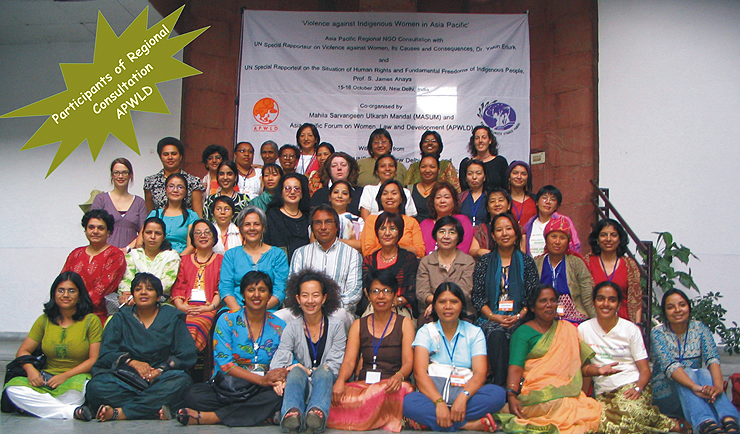
PWESCR invited Romanian lawyer Ramona Biholar to lead discussion on relevance of CEDAW in the Caribbean during her brief visit to PWESCR on Sept 29, 2008. She highlighted the peculiar and acute situation of Jamaican women’s rights linked intrinsically to the social norms and gender inequalities. The discussion provided the participants with a platform to share their ideas on the implementation of CEDAW and to work on better implementation strategies in future and also enhance their learning. Beside this it also raised the issue of domination of western powers in field of Human Rights. But most importantly she addressed the issue of dichotomy that exists between social action and research. |
INDICATORS FOR HUMAN RIGHTS ASSESSMENTS
24 September, 08
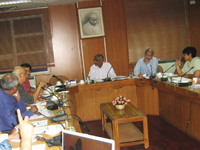
The presentation by Rajeev Malhotra a development economist, and who has worked with the Office of High Commissioner of Human Rights in Geneva and is working presently at Ministry of Finance, Department of Economic Affairs provided an assessment of some of the major initiatives and approaches to develop quantitative human rights indicators for monitoring human rights in recent times and helped the participants to see the advantages of using a structured approach in identifying indicators for use in monitoring the progressive realization of human rights, violation of human rights and the implementation of human rights obligations of States who are party to international human rights treaties. |
|
Report on Indicators for Promoting and Monitoring The Implementation of Human Rights
FORMATION OF WORKING GROUP TO MONITOR SOCIAL SECURITY
24 September, 08
|
As several people were working towards a comprehensive legislation on social security in India, PWESCR is also equally concerned about the low priority and lack of monitoring of National Social Assistance Programmers and as we continue to define content and coverage of social security for all we felt a need to examine the effective implementation and monitoring mechanisms for which we formed the National Working Group to monitor Social Security after having a meeting at the Planning Commission. The group consists of members from both the Government and Social Security and will fill in the two major gaps i.e. lack of clarity in content and |
coverage and inadequacy in monitoring. After the meeting members even went to the extent of thinking of directly talking to the ministries on issue and also to develop a base paper. |
|

STRATEGY MEETING FOR IMPLEMENTATION OF CONCLUDING OBSERVATION
13 September, 08
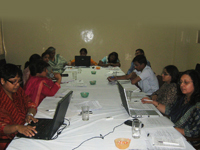
This meeting was a follow up of the earlier meeting held on July 27, 08 to discuss on the next steps and strategies for the implementation of the concluding observation. Meeting started with a quick recap of the collective process of July 24 and the three subgroups then presented their views and raised the issues. The three important things which got identified were to raise awareness, do advocacy and to form a pressure group for monitoring and documentation. Some important decisions that got made were that need to have short term and long term process – short term process included |
|
- Translation of the concluding observation
- Dissemination of information at National and State level where as the long term process included
- Awareness and to develop a kit
- Roundtable conference for ministries and one to one interaction with them
Home | About Us | Financials | Resources | Donation | Contact Us | Site map
Copyright 2008, All Rights Reserved. PWESCR.